


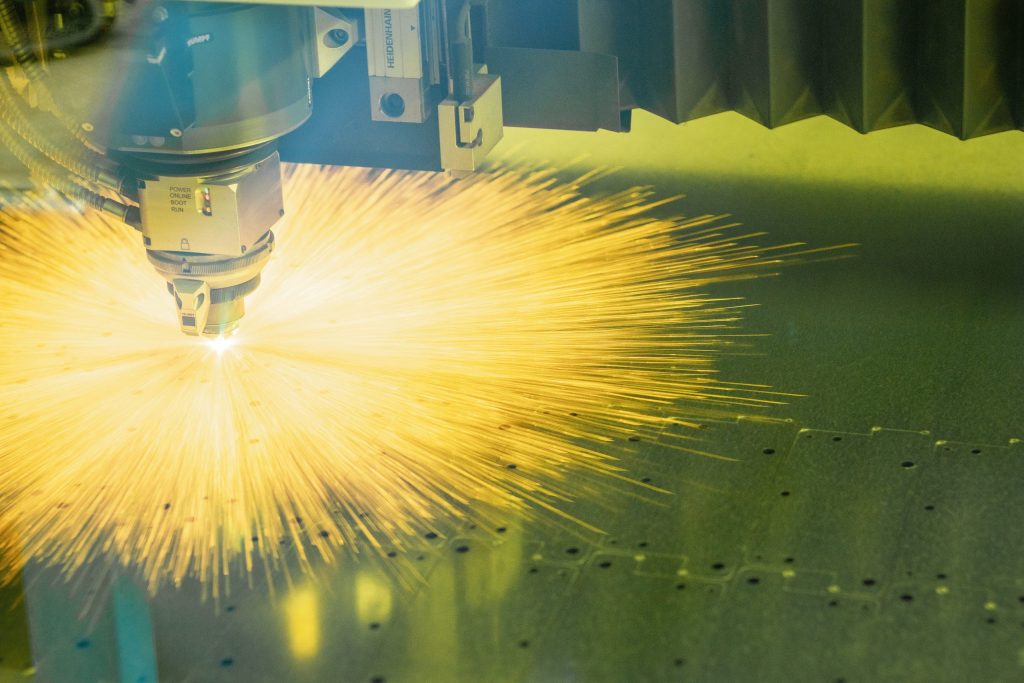
Laser cutting is one of the most advanced and versatile techniques for manufacturing metal parts, widely used in sectors such as automotive, aerospace, construction, and industrial machinery manufacturing.
What exactly is laser cutting? It is a manufacturing process that uses a high-power laser light beam to cut or engrave materials. This laser light beam is focused on a very small area, making it possible to cut any metallic material with great precision and detail. It also includes a high-pressure gas system to remove the materials that melt during the process and is ideal for parts with complex shapes, offering great design flexibility.
Briefly explained, the process works as follows: the laser is directed at the material to be cut and generates intense heat, melting or vaporizing the material along a precise line. The result? A clean cut with very smooth edges, reducing the need for subsequent finishing processes.
Laser cutting offers a number of advantages, such as high-precision cuts, clean edges, and minimal deformation, but each material presents specific challenges during the process. Choosing the wrong metal or thickness can affect both the final quality of the part and the cost of the process.
Would you like to know which key factors to consider when selecting a material for laser cutting? From the thermal properties of metals to how they interact with cutting technology, understanding these factors helps optimize the process and ensure the best results.
Common types of materials for laser cutting
Laser cutting is effective on a wide variety of metallic materials, but it is important to bear in mind that metals that conduct heat better are usually more difficult to cut. The same applies to shiny metals, which reflect the laser light and increase the complexity of the process. For this reason, it is essential to choose the right material for each project based on its mechanical, chemical, and thermal properties. The most common materials used in metal laser cutting include:
Cutting ferrous metals
- Stainless steel: ideal for applications that require corrosion resistance, such as the food and pharmaceutical industries, delivering precise cuts and clean edges.
- Iron: used in structural applications and heavy manufacturing, allowing precise cuts in large, thick parts.
- Steel: used across various sectors for its strength and versatility, enabling precise cuts in a range of thicknesses.
Cutting non-ferrous metals
- Aluminum: common in the automotive and aerospace industries, it is more challenging due to its reflectivity, but fiber laser ensures precision.
- Copper and reflective metals: fiber laser cutting is ideal for these metals, maintaining quality even with difficult materials.
- Anodized aluminum: its treatment improves resistance, and laser cutting delivers precise, durable results.
- Chrome: offers high resistance to corrosion and wear, with precise cuts for a wide range of industrial applications.
Cutting metal sheets
- Sheet metal laser cutting: enables fine, detailed cuts in metal sheets, with high efficiency and minimal material loss.
- Sheet metal cutting and bending: combines cutting and bending to create complex parts with high precision and specific formats.
Other commonly used metals in laser cutting
- Brass: used in jewelry and electronics, laser cutting makes it possible to achieve fine, precise details.
- Painted metal: requires careful calibration, but precise cuts can be achieved without damaging the paint.
- Precious metals: laser cutting is ideal for gold, silver, and platinum, enabling intricate jewelry cuts without affecting quality.
- Titanium: used in aerospace and medical applications, laser cutting delivers precise cuts despite its high strength.
Material thickness: a crucial factor
Material thickness is another fundamental factor when selecting metal for laser cutting. Lasers have a limited capacity to cut very thick materials, which can affect both cut quality and process speed.
When working with very thick metals, a higher-power laser, such as fiber laser cutting, or a longer cutting time may be required. In any case, advances in laser cutting technology are enabling high-power lasers to cut thicker materials with similar quality.
At JOM, we have 3 lasers of up to 24 kW of power, capable of cutting materials with thicknesses ranging from 0.3 mm to 25 mm. Standard tolerances in laser cutting are ±0.1 mm, which guarantees high precision in demanding applications. This technique is ideal for thin sheets, as it minimizes deformation and reduces the need for additional adjustments.
Thermal and reflective properties of the material
The thermal behavior of the material is another aspect that directly impacts cut quality. During the laser cutting process, the metal is heated to high temperatures, which can cause distortions or deformations if the material does not behave properly under heat.
Some materials, such as aluminum or copper, are highly reflective, which can affect the precision of laser cutting. Steel, by contrast, has greater thermal absorption and is better suited to high-precision cuts. Materials with high thermal conductivity, for their part, require specific adjustments in the cutting process to prevent heat from dissipating too quickly, which would make a clean cut more difficult.
On the other hand, the surface finish of the metal also plays an important role when choosing a material for laser cutting. If a clean finish is required, it is crucial to select a material that allows controlled melting of the metal.
Choosing the right material for laser cutting is crucial to ensuring efficient, cost-effective, high-quality production. If you have questions about laser cutting or which material is best suited to your project, or if you need specialized advice, our team is ready to help you find the best solution for your metal parts manufacturing needs.